Sunday, September 14, 2014

Disaster Choreography

On board a Konkan Railway train
 A couple of months ago, the incessant rains caused an ill-constructed neighbouring wall to collapse on the compound wall of our residential complex and they both came crashing down. Fortunately - rather, miraculously - no one was injured and there was little damage to any property except for the wall itself.

The South Goa Planning and Development Authority has thoughtfully created a "District Disaster Management Authority". Unfortunately, in doing so, they raised my expectation. And so it was, that I was taken aback when, on submitting a written communication asking them to help, the idiot lady (I do believe "idiot" is a unisex word) sleepily asked us to check back after 8 days to know the "status" of our "complaint" without so much as bothering to read or know what we had come to report.

I don't mean to single out the SGPDA for this non-response. Indeed, as a nation, and perhaps as a race, we have not (yet) internalized the notion and the significance of disaster preparedness and recovery.

But what churns my stomach, is the "choreography" that goes into any and every disaster we are faced with. When I say "choreography", I don't mean it as a metaphor for "manufacturing" the disaster in the first place; rather, I am really referring to the post-incident posturing that we seem to have become experts at.

From the Arnabs who wallow in their own superciliousness to clueless political figureheads who just want some airtime, we have no dearth of entities who add absolutely no value. Not even to their own faces or to their own (dis)repute.

The long-decayed-icing on the cake though, is this:

Pictures predominantly from PIB

If there's anything and anyone that can make the scripts of Ekta Kapoor's "K brigade" look like a Steven Spielberg potboiler, it simply has to be the idea and its inventor (perhaps the brainchild of Doordarshan) of making us watch politicians watch disaster-prone areas. And for this, I would blame the media more than the politicians.

Aerial survey of a disaster-struck zone - sad as it may be - is newsworthy. But covering a politician peering out of a plane purportedly flying over a disaster zone? Now, that's a disaster.


Just so you can gauge for yourself, try this: do a Google image search for "aerial survey" and then search for "aerial survey of disaster". See the results that show up for each. The pictures will speak a thousand words.


Since we now have a PM who has after ages delivered a I-Day speech from the heart instead of by-heart, who has stepped in to question why so many scrooges needed to accompany the athletes to Incheon, and who has asked people to assist in J&K aid instead of celebrating his birthday - and hopefully truly meant all of those - I will rely on him to please stop this parody+travesty+ignominy of "disaster recovery".

Please, Mr. PM. We need true disaster prevention, preparedness and recovery. No more disaster choreography.

Wednesday, January 29, 2014

A Star is Born

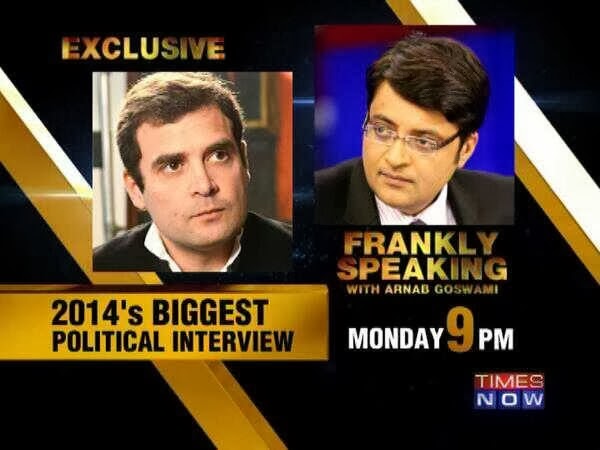
Even if it would further empower the common man - and of course, woman - to exercise her/his right to information by opening up the system and making it more transparent as has been attempted by several generations of his noble family, I couldn't possibly say anything that hasn't already been said about RaGa's now-legendary interview by ArGo.

The reactions to the interview do not really surprise me. To me, it was a foregone conclusion; a predictable outcome; I hadn't even bothered to watch the interview. Notwithstanding the fact that I can't - couldn't - stand the interviewer anyway. Of course, I was tracking the steady stream of sentiments being expressed on social media.

What I had not anticipated though, was the overwhelming intensity of the reaction and the barrage of humour. It were these two factors that drew me to the interview.

To my surprise, I was surprised.

In my eyes, a potential star was indeed born in yesterday's interview.

Not RaGa, but ArGo.

The ArGo I have seen - on the miserable occasions that fate has plonked me at 9PM in front of a TV tuned to TimesNow and whose remote-control I had no authority over - is an ArGo that I shun. That is the ArGo who believes he alone is the nation's conscience keeper. The ArGo who believes the nation has appointed him its spokesperson through a overwhelmingly unanimous referendum. The ArGo that believes that a "debate" is a monologue-in-disguise where the moderator sequentially shouts out the same question to as many people as can be fitted on a TV screen (but by waiting till one speaker starts speaking before posing the same question to the next person, thereby cutting off the speaker). The ArGo that believes an entire nation is patiently waiting for him to beat an answer out of the (usually) vile interviewee and hand it over so the nation can use that answer to save itself from apocalypse and redefine its own fate.

Heck. ArGo was the single largest reason I couldn't stand ArGo.

Imagine my surprise therefore, when I saw a transformed ArGo interviewing RaGa.

The answers that RaGa gave are not to be held against him nor are to be used to judge or crucify him. Rather, they are a measure of ArGo coming of age. How many other interviewees on his show have been allowed to complete what they wanted to say? Let alone give irrelevant answers.

The apparent digression that RaGa seemed to be lapsing into mustn't distract us from the gem it revealed. It was a test for ArGo. A test that he passed - in my view - with flying colours. ArGo kept returning - with respect (what?! what?!) - to specifics, to elicit a response.

The repeated stress by RaGa on the same set of concepts shouldn't cause us to defocus from the larger point. For the first time in my life, I was reaching for the remote when ArGo was speaking, to INCREASE the volume. Not to decrease it. Nor even to change the channel.

For a change, there was no melodrama. And any drama if at all, was definitely mellow.

Above all, ArGo used the word "nation" only 3 times. And that too, only when he uttered the words "assassination", "nomination" and "destination".

I am not joking and I am not being sarcastic when I say I was pleasantly surprised by ArGo. It appears that he has indeed had an education. It appears that he can indeed be effective by being civil. It appears that he can in fact do his job - and how - at sub-100-decibel levels and devoid of hot air.

For the copious amount of homework you do ArGo, you owe it to yourself to emerge as a professional journalist not prone to molly-coddling rather than a supercilious anchor who wants his career to be defined by cacophony and melodrama.

Do you have it in you, ArGo? Have you really come of age?

The Nation wants to know, ArGo; the Nation wants to know.

Monday, November 11, 2013

The powerful charm of biometrics-based loyalty management

In an age where we are so used to technology smashing through its own boundaries all the time, it takes quite something for technology to take a revolutionary leap instead of an evolutionary one. It takes quite something for a technology to pack some “WOW” punch into its results.

Udupi – a small, tier-3 temple town – isn’t particularly the first place you would think of when you think of technology.

Udupi Residency is a somewhat nondescript hotel in the town of Udupi. I have been using this hotel during my not-infrequent trips to Udupi for over 8 years now. It’s certainly not a hotel that I would pick if I were vacationing. Pick any parameter that you would want to rate a hotel on, and I might give it a 2.5 in my most generous moments. Yet, ask me to pick a hotel in Udupi for a night or two that is family-friendly, conveniently-located, economical, offers good service and all I want the room for is to sleep at night and get ready in the morning, and I will unhesitatingly pick this hotel.

Then again, ask me to list the hotels that have wowed me with effective use of customer-delighting technology and Udupi Residency wouldn’t have figured in the top-5,000. Heck, it doesn’t even have an internet connection for guests, let alone WiFi.

I was therefore pleasantly surprised by my recent experience – and somewhat taken aback by the consequent realization – of how Udupi Residency has leveraged a very sophisticated biometrics-based loyalty recognition technology at all levels.

Starting with the watchman who helped me park. He greeted my effusively as I got out of the car and even apologized that he didn’t realize “it was me”.

I stopped dead in my tracks, dumbfounded.

It was only the first of the surprises in store for me, though. It was more than 8 months since I had last stayed at the hotel and I didn’t expect that anything had changed. But the receptionist, the bell-boys, the waiters in the in-house restaurant and the room-service boys were all equipped with this powerful solution and readily flashed me a “hello-again” smile.

What really took the cake – or served as the icing on it if you may – was at breakfast the next morning. The bashful morning-shift waiter gave me a “hey-its-you-again” smile and when I asked for the menu, he waved off my request, saying “Same menu, saar. Nothing new” instead of handing me the menu.

Early in my professional career, I was closely involved in building a fairly intricate and powerful loyalty and rewards management engine. Among other complexities, one of the particularly challenging features that we were proud of was the deduplication algorithm we were running. And here I was in Udupi seeing a far more sophisticated "deduplication" technology in action. 

Without a single line of code.

It took a while to sink in.

But when it finally did, I was left fascinated at how the most powerful and complex technologies we have today pale in comparison to the oldest biometric technology in the world: old-fashioned facial recognition by human beings. The most powerful loyalty management software in the world.