Sunday, March 29, 2015

There's no flavour like nostalgia

"Diana", a restaurant in Udupi, is one of those legendary restaurants that has served multiple generations of many families - mine included. It was first introduced to me earlier than the "start of my memory" - perhaps by my maternal uncle. It made eating out fashionable even in the day when eating out was clearly unfashionable. My Dad unfailingly accommodated my agenda of visiting Diana at least once on every visit to Udupi.

Earlier this month, I happened to visit Diana after a gap of nearly 8 years. Of course, they've moved from their "flagship location" at "Diana Circle" (which still continues to be called that) to their own swanky building now with tailor-made interiors; and have expanded way beyond just a restaurant. But other than that, it was still the same. I couldn't tell for sure whether the furniture was the same, but the waiters were. So was the menu. And most satisfyingly, so was the flavour of their food.

Unbelievable consistency
for the last 30 years
(please pardon the quality of the picture)
The visit was even more memorable because it also marked the introduction of the restaurant - and my favourite items on their menu - to the third generation of the family: my son.

As I heartily tucked in the food and watched my son do the same by my side - with my Dad sitting across the table from us - the flavour in my mouth generated a million memories in a span of few seconds.


And that was some food for thought for me: that there's no flavour like nostalgia. 

Friday, September 26, 2014

The Story of my Upgrade to Colour

Professionally, I grew up in the world of technology.

Despite the aura and glamour it has, it's really a "black and white" world: your code either compiles or it does not; the syntax is either right or wrong; the API either scales or fails. Quite literally, a binary world where decision-making is rule-driven for the most part and outcomes are largely predictable.

I therefore found myself wanting as I grew beyond a pure technical role and entered the realm of decision-making driven by humans and human semantics rather than by syntax and design semantics.

I found myself as overwhelmed as I was mesmerized  by the hues, tints, tones and shades of all colours, including gray that define the non-technical, non-binary world. The influence of the human element in decision-making was far too real and far too significant not to recognize and not to accept.

One of my first lessons - and indeed my first step in my "upgrade to colour" - was when I switched from an engineering role in India to a pre-sales role in the Valley.

My first pre-sales assignment was with a prospect - a Valley startup - that wanted to "port their Python code-base to Java". The company had a location-based product that was delivered through a traditional web portal, mobile web and a mobile application.

In response, we went "well-prepared" - corporate deck, relevant case studies, execution methodology, what-have-you.

It was a 90-minute meeting with the CTO (who had just come on-board) and his 7-member engineering team.

The meeting exploded in our faces.

The porting project had a stillbirth – both, because of us as well as for reasons beyond our control and beyond our meeting.

As I reflected upon that meeting, I distilled out two important lessons:

  1. Business, political and human considerations and compulsions rule over and overrule everything else: it was a new CTO who had mooted the idea of the porting to Java without fully bringing on board, his engineering team – an all-Python team including an author of a book on Python! To make matters worse, the team was never too kicked about outsourcing. Last but not the least, the business didn't see anything "broken" (with the Python platform) that needed to be "fixed" (with Java). Needless to say, we were seen by the team as the villains roped in by the new CTO to do his dirty work. The technical merits of Java vis-à-vis Python and vice-versa never even figured in our discussions.

    I have learnt and re-learnt with many a junior team-member that this is the most important lesson and the rudest awakening for the software engineer that believes that technology is supreme. More importantly, countless more fail to learn this lesson.
  2. Don’t assume you know enough to make assumptions – we knew a lot about the company through direct information and research, but assumed we knew enough to make assumptions. We assumed that the decision to port had been carefully considered and thought-through from technical and non-technical angles. We assumed the team was on-board. We assumed "outsource" meant "offshore".

    We assumed we were making safe assumptions.

    We made assumptions.

    Her famous child followed.

As I moved not just beyond a technical role, but indeed beyond the world of technology, the hues, shades and tints came into greater play. Be it the wily business associate you have to deal with, or the shy employee you're trying to groom or the hopelessly suspicious colleague who wants to randomly verify Excel calculations on his 12-digit super-reliable Casio calculator or the weird wisdom of todays' court verdicts or the inexplicable non-alignment of your priorities with your wife's or the "timely" tantrum your 5-year-old will throw. 

The possible outcomes are rarely binary and the only predictability is in the unpredictability.

My upgrade to colour continues and is perpetually incomplete, but the two lessons I learnt from my first pre-sales meeting are keepers. 


(Based on an article I originally wrote for a portal run by a friend of mine which has since wound up)  

Sunday, September 14, 2014

Disaster Choreography

On board a Konkan Railway train
 A couple of months ago, the incessant rains caused an ill-constructed neighbouring wall to collapse on the compound wall of our residential complex and they both came crashing down. Fortunately - rather, miraculously - no one was injured and there was little damage to any property except for the wall itself.

The South Goa Planning and Development Authority has thoughtfully created a "District Disaster Management Authority". Unfortunately, in doing so, they raised my expectation. And so it was, that I was taken aback when, on submitting a written communication asking them to help, the idiot lady (I do believe "idiot" is a unisex word) sleepily asked us to check back after 8 days to know the "status" of our "complaint" without so much as bothering to read or know what we had come to report.

I don't mean to single out the SGPDA for this non-response. Indeed, as a nation, and perhaps as a race, we have not (yet) internalized the notion and the significance of disaster preparedness and recovery.

But what churns my stomach, is the "choreography" that goes into any and every disaster we are faced with. When I say "choreography", I don't mean it as a metaphor for "manufacturing" the disaster in the first place; rather, I am really referring to the post-incident posturing that we seem to have become experts at.

From the Arnabs who wallow in their own superciliousness to clueless political figureheads who just want some airtime, we have no dearth of entities who add absolutely no value. Not even to their own faces or to their own (dis)repute.

The long-decayed-icing on the cake though, is this:

Pictures predominantly from PIB

If there's anything and anyone that can make the scripts of Ekta Kapoor's "K brigade" look like a Steven Spielberg potboiler, it simply has to be the idea and its inventor (perhaps the brainchild of Doordarshan) of making us watch politicians watch disaster-prone areas. And for this, I would blame the media more than the politicians.

Aerial survey of a disaster-struck zone - sad as it may be - is newsworthy. But covering a politician peering out of a plane purportedly flying over a disaster zone? Now, that's a disaster.


Just so you can gauge for yourself, try this: do a Google image search for "aerial survey" and then search for "aerial survey of disaster". See the results that show up for each. The pictures will speak a thousand words.


Since we now have a PM who has after ages delivered a I-Day speech from the heart instead of by-heart, who has stepped in to question why so many scrooges needed to accompany the athletes to Incheon, and who has asked people to assist in J&K aid instead of celebrating his birthday - and hopefully truly meant all of those - I will rely on him to please stop this parody+travesty+ignominy of "disaster recovery".

Please, Mr. PM. We need true disaster prevention, preparedness and recovery. No more disaster choreography.

Wednesday, January 29, 2014

A Star is Born

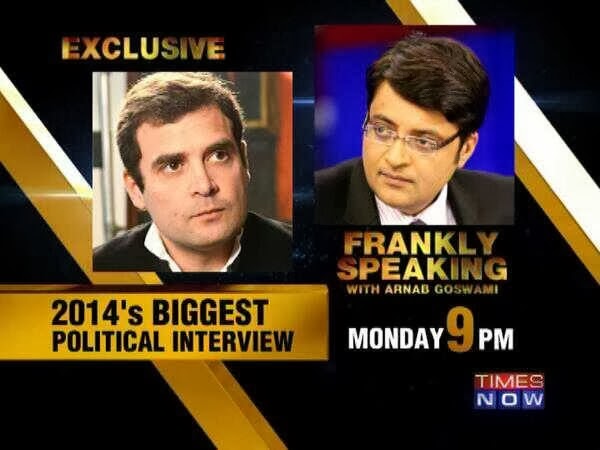
Even if it would further empower the common man - and of course, woman - to exercise her/his right to information by opening up the system and making it more transparent as has been attempted by several generations of his noble family, I couldn't possibly say anything that hasn't already been said about RaGa's now-legendary interview by ArGo.

The reactions to the interview do not really surprise me. To me, it was a foregone conclusion; a predictable outcome; I hadn't even bothered to watch the interview. Notwithstanding the fact that I can't - couldn't - stand the interviewer anyway. Of course, I was tracking the steady stream of sentiments being expressed on social media.

What I had not anticipated though, was the overwhelming intensity of the reaction and the barrage of humour. It were these two factors that drew me to the interview.

To my surprise, I was surprised.

In my eyes, a potential star was indeed born in yesterday's interview.

Not RaGa, but ArGo.

The ArGo I have seen - on the miserable occasions that fate has plonked me at 9PM in front of a TV tuned to TimesNow and whose remote-control I had no authority over - is an ArGo that I shun. That is the ArGo who believes he alone is the nation's conscience keeper. The ArGo who believes the nation has appointed him its spokesperson through a overwhelmingly unanimous referendum. The ArGo that believes that a "debate" is a monologue-in-disguise where the moderator sequentially shouts out the same question to as many people as can be fitted on a TV screen (but by waiting till one speaker starts speaking before posing the same question to the next person, thereby cutting off the speaker). The ArGo that believes an entire nation is patiently waiting for him to beat an answer out of the (usually) vile interviewee and hand it over so the nation can use that answer to save itself from apocalypse and redefine its own fate.

Heck. ArGo was the single largest reason I couldn't stand ArGo.

Imagine my surprise therefore, when I saw a transformed ArGo interviewing RaGa.

The answers that RaGa gave are not to be held against him nor are to be used to judge or crucify him. Rather, they are a measure of ArGo coming of age. How many other interviewees on his show have been allowed to complete what they wanted to say? Let alone give irrelevant answers.

The apparent digression that RaGa seemed to be lapsing into mustn't distract us from the gem it revealed. It was a test for ArGo. A test that he passed - in my view - with flying colours. ArGo kept returning - with respect (what?! what?!) - to specifics, to elicit a response.

The repeated stress by RaGa on the same set of concepts shouldn't cause us to defocus from the larger point. For the first time in my life, I was reaching for the remote when ArGo was speaking, to INCREASE the volume. Not to decrease it. Nor even to change the channel.

For a change, there was no melodrama. And any drama if at all, was definitely mellow.

Above all, ArGo used the word "nation" only 3 times. And that too, only when he uttered the words "assassination", "nomination" and "destination".

I am not joking and I am not being sarcastic when I say I was pleasantly surprised by ArGo. It appears that he has indeed had an education. It appears that he can indeed be effective by being civil. It appears that he can in fact do his job - and how - at sub-100-decibel levels and devoid of hot air.

For the copious amount of homework you do ArGo, you owe it to yourself to emerge as a professional journalist not prone to molly-coddling rather than a supercilious anchor who wants his career to be defined by cacophony and melodrama.

Do you have it in you, ArGo? Have you really come of age?

The Nation wants to know, ArGo; the Nation wants to know.

Monday, November 11, 2013

The powerful charm of biometrics-based loyalty management

In an age where we are so used to technology smashing through its own boundaries all the time, it takes quite something for technology to take a revolutionary leap instead of an evolutionary one. It takes quite something for a technology to pack some “WOW” punch into its results.

Udupi – a small, tier-3 temple town – isn’t particularly the first place you would think of when you think of technology.

Udupi Residency is a somewhat nondescript hotel in the town of Udupi. I have been using this hotel during my not-infrequent trips to Udupi for over 8 years now. It’s certainly not a hotel that I would pick if I were vacationing. Pick any parameter that you would want to rate a hotel on, and I might give it a 2.5 in my most generous moments. Yet, ask me to pick a hotel in Udupi for a night or two that is family-friendly, conveniently-located, economical, offers good service and all I want the room for is to sleep at night and get ready in the morning, and I will unhesitatingly pick this hotel.

Then again, ask me to list the hotels that have wowed me with effective use of customer-delighting technology and Udupi Residency wouldn’t have figured in the top-5,000. Heck, it doesn’t even have an internet connection for guests, let alone WiFi.

I was therefore pleasantly surprised by my recent experience – and somewhat taken aback by the consequent realization – of how Udupi Residency has leveraged a very sophisticated biometrics-based loyalty recognition technology at all levels.

Starting with the watchman who helped me park. He greeted my effusively as I got out of the car and even apologized that he didn’t realize “it was me”.

I stopped dead in my tracks, dumbfounded.

It was only the first of the surprises in store for me, though. It was more than 8 months since I had last stayed at the hotel and I didn’t expect that anything had changed. But the receptionist, the bell-boys, the waiters in the in-house restaurant and the room-service boys were all equipped with this powerful solution and readily flashed me a “hello-again” smile.

What really took the cake – or served as the icing on it if you may – was at breakfast the next morning. The bashful morning-shift waiter gave me a “hey-its-you-again” smile and when I asked for the menu, he waved off my request, saying “Same menu, saar. Nothing new” instead of handing me the menu.

Early in my professional career, I was closely involved in building a fairly intricate and powerful loyalty and rewards management engine. Among other complexities, one of the particularly challenging features that we were proud of was the deduplication algorithm we were running. And here I was in Udupi seeing a far more sophisticated "deduplication" technology in action. 

Without a single line of code.

It took a while to sink in.

But when it finally did, I was left fascinated at how the most powerful and complex technologies we have today pale in comparison to the oldest biometric technology in the world: old-fashioned facial recognition by human beings. The most powerful loyalty management software in the world.

Sunday, October 27, 2013

Reciprocity

Like many other kids of my day & age I used to be an avid reader of Amar Chitra Katha.

One story that left an impression on me was of these two kings whose chariots came to block each other on a narrow bridge. The first charioteer submits to the second charioteer that the latter must make way for the first king since the first king was held in high esteem by his subjects and that "he did good to those who did him good and retaliated against those who sought to harm him". To which the second charioteer responds, "In that case, it is your king who must make way. For, my king is held in high esteem because he does good to those who do him good and even to those who seek to do him harm".

The first charioteer and king at this point, bow to the second king and acknowledge that the latter is indeed the greater one for he does good to those who do him good as well as to those who seek to do him harm.

The moral of this story - viz., do good to all whether or not they do good to you - served to reinforce the various incarnations of "do unto others as you would have them do" that were taught to us kids all the time. It also seemed to explain Gandhiji's "turn the other cheek" doctrine - another common refrain we were taught to drive home the point that violence isn't the right answer to violence.

These were my first and early lessons in "reciprocity" and its influence.

As we grew up though - and out of the Utopian world we created from our own innocence - we naturally began questioning the wisdom and efficacy of such total abstinence from aggression.

Sometimes consciously, sometimes sub-consciously; sometimes philosophically, sometimes out of despair; the doubts in our mind kept growing - as did our inability - to refrain from tit-for-tat.

In our lives and our roles at work and home, we encounter a slew of personalities. Whether or not we rationalize people's behaviours and whether or not we understand their intent and circumstances, fact of the matter is, we have to deal with unpleasantness. Sometimes it's benign irritants we have to deal with; sometimes it's an impulsive verbal jab that hurts; sometimes it's plain rudeness; sometimes it's inconsiderate behaviour; at times it's even ill-concealed malafide intent.

I am often faced with a quandary under such circumstances. Do I continue to do unto others as I would have them do, or do I do unto others as they did? Do I yield to someone who is deliberately trying to manipulate me to suit his or her own agenda or do I manipulate in return? Do I continue to be graceful to someone who is a pain-in-the-<whatever> or do I too make a nuisance of myself?

Sometimes it's just a matter of a behavioural trait. Do I don the hat of a diplomat and a gentleman even when dealing with a rogue? Or do I sully my own dignity and respond in their wavelength? Do I continue being kind to a jealous neighbour or do I repay his or her pettiness? Do I act haughty with an arrogant, selfish person or do I just continue being above-board? Do I continue accommodating the requests and whims of someone who is rigid and inflexible all the time or do I just tell him/her to go **** a tree?

But sometimes it gets darker and skirts matters of conduct and integrity. Do I cheat because I am dealing with a cheater and he has cheated me anyway? Do I indulge in sharp practices to settle scores with someone who has anyway taken advantage of me?

And then there's the role of reciprocity in international relations. Does possession of nuclear arms truly act as a deterrent or does it in fact, spur an arms race? Does stoic diplomacy always yield results or should you once in a while just get out of your chair and kick the aggressor hard where it hurts? By the same token, does aggression cause the opponent to cower or does it just foster a sense of hatred and revenge?

The answers aren't easy to come by and there's hardly ever a clear-cut answer or a black-and-white choice to make. There is always the temporary and vindictive joy to be sought by repaying unkindness with inkindness, but there's also the danger of setting of a continuing chain reaction.


Most far-reaching though, is perhaps reciprocity's other side: its utility as a subtle but effective behaviour-influencing tool. Reciprocity is after all, the basic human instinct to mirror the very treatment one receives.

When it comes to dealing with difficult people, I consider my father's and grandfather's track record to be an exemplary one. I have seen them persuasively drive things to an advantageous closure with many a obstinate moron, arrogant scoundrel and shrewd manipulator where the instinct of the average person - mine, certainly - would be to just reach out and deliver one tight slap. At least verbally, if not physically.

My abilities are a far cry from theirs but my limited attempts have yielded fascinating results. Be it trying to inculcate simple disciplines at the work-place, be it laying down an implicit code of conduct with children, be it making requests for some extra effort or be it negotiating prices with a measly vendor - not only has kindness, respect or considerate behaviour been reciprocated, but more importantly, by not succumbing to the temptation of reciprocating, tact won the day.


That is not to say that you blindly turn the other cheek. Indeed, experts believe that Gandhiji's satyagraha would have failed had it been Hitler and not the British that he was dealing with. In times of such quandary, I am reminded of another story I read. This one too, in Amar Chitra Katha, and is one that balanced out in some way, the story of the kind king's chariot.

There was this cobra that used to menace a village till one day, an ascetic bemoaned him to leave the villagers in peace. The cobra heeds this advice and begins to lead a peaceful life. 

A few days later, some children from the village happen to see the cobra lying still. They presume the cobra is asleep and decide to avenge all the months of trouble they faced at the hands of the snake and attacking it sticks and stones. Heeding the sage's advice, the cobra lies still and is badly injured.

That evening, the sage happens to come by and finds the injured cobra and asks what happened. When he hears what happened, he admonishes the cobra for lying still when he was attacked. 

"I told you not to bite, but I didn't tell you not to hiss".

Sunday, March 03, 2013

Through the Looking Glass

Before my very eyes, a year has passed!

At this time last year, I had just woken up with an overwhelming sense of "melancholy anticipation" as my wife and I prepared to turn the page on what has clearly been the most exhilarating chapter of our lives.

Notwithstanding our kind friends who stopped by to help (one of whom just took the day off impromptu in order to help us!), the tasks for the day ahead were as daunting as they were trivial: daunting in terms of the sheer volume of pending work, and yet seeming so trivial in comparison to the enormous leap of faith we were about to take and the uncertainties - of sorts - that lay ahead.

As I look back, I am bemused at the paradoxes that have defined the year - the very things we cherished so much turned out to be the source of our pain: the very friends with whom we forged the strongest bonds were the very cause of our relocation becoming so difficult! The very values, practices and mindsets that gave us our foundation as children and then as adults turned out to be at loggerheads with what lay ahead, as we grappled with a transition that spanned geographies and professions and a transition that had to bridge generation gaps and lifestyle-whitespaces.

As I lay suspended between yesterday and tomorrow, it is perhaps time to stop being fixated on the reflection in the mirror and focus on what lies ahead. It is perhaps time to look "through the looking glass". 

Great Places to Work: Perceptions, Trade-offs and Happiness

  Agonda Beach, Goa. Imagine this is your workplace.  Nestled in the lap of nature.  Where the dominant workplace sounds are not ringing pho...